Page 6 of 7

Work, ambition and thinking

16 notesUpdated 20 minutes agoJump to latest
Ask your AIChatGPTClaude

N16

How to Be an Expert in a Changing World · Dec 2014 If the world didn't change, beliefs that survived more experience would deserve more confidence. But most things change, and experts are often wrong because they're experts on an earlier version of the world. PG shares tricks from almost a decade of startup investing (as of 2014) for noticing when your beliefs have gone stale.

The trap

  • Most people's confidence in their opinions only rises, as if the world were static. That works for human nature, not much else.
  • Many really good startup ideas look bad at first, often because some change just flipped them from bad to good.

How to guard against stale beliefs

  • Believe in change explicitly. Reminding yourself makes you look for it.
  • Don't try to predict it; change that matters comes from where you didn't expect. Be "aggressively open-minded" instead.
  • Working hypotheses are fine, since they motivate you, but don't let them harden. Be extra skeptical once one becomes linked to your name.
  • Get ideas by solving problems and not dismissing weird hunches. If you're expert enough, any weird idea is worth exploring, and that can take just a year of focused work plus caring a lot. At YC, calling an idea crazy is a compliment.
  • Turn comments into bets. Investors must say yes or no and soon learn if they were right; those who said no to Google (several did) never forget it. Writing in a durable, public form does the same. Forum and Twitter posts act like casual talk; the line may be whether it has a title.
  • Focus on people before ideas. Good new ideas come from earnest, energetic, independent-minded people. YC thought Airbnb was a bad idea but funded the founders for these traits.
  • Be friends with the people whose discoveries will make your beliefs obsolete.

What he's unsure about

  • Change has sped up since the paleolithic era, so staying current gets harder. He expects that to continue, but says he could be wrong.

Ask yourself (our questions, not PG's)

  • Which of my beliefs about my market formed before something important changed?
  • Have I written my key bets down publicly enough to feel it if they're wrong?
  • Who are the earnest, energetic, independent-minded people I should spend more time with?

N15

When To Do What You Love · Sep 2024 Whether to "follow your passion" has no simple yes or no, so PG traces where the line falls. If your main goal is money, you usually can't afford to work on what interests you most. But if you want huge wealth through a startup, or want to do great work, following your interests becomes the right move.

When interest and money line up

  • People pay you to do what they want, not what you want, unless you both want the same thing, like playing football well enough to get paid. Odds are poor there, since so many others want it too.
  • Odds are better with strange tastes. Bill Gates loved not just programming but writing software for customers.
  • Some people find making money an intellectual puzzle: they can't help spotting things that are mispriced.

The "midwit peak"

  • Need little money: work on what interests you. Want to be moderately rich: you usually can't. Want to be super rich, and you're young and good at technology: interests win again.
  • Huge money comes from startups, and following your interests is a great way to find startup ideas. Apple, Google and Facebook began as fun projects.
  • The best ideas are such outliers you'd miss them if you hunted for money.

When you can't decide

  • A tie between interest and money is only apparent. It comes from three kinds of ignorance: what makes you happy, what the work is really like, and how good you'd be at it.
  • Get more certainty by trying things. Don't wait for the end of college or even internships; you often don't need a job doing x to do x.
  • Look at who your colleagues would be, because you'll become like them. His test: if it didn't pay, would they do it in their spare time? Many mathematicians, scientists and engineers would; he doubts as many investment bankers would.
  • "Staying upwind": when unsure, keep more options open. Choose math over economics, since switching from math to economics is easier than the reverse.

Great work is the clear case

  • To do great work, working on what interests you most is necessary, though not sufficient. That's why most famous successes give this advice: for them it's true.
  • If you want great work, the answer is yes. Its root is "ambitious curiosity," which you can't manufacture.

Ask yourself (our questions, not PG's)

  • Did my startup idea come from real interest, or from hunting for money?
  • Would I keep working on this if it never paid?
  • Which of my current choices keep me "upwind"?

N14

Early Work · Oct 2020 The fear of making something lame stops many people from doing great work. Ambitious projects often look unimpressive at first, even to their makers, and we judge them like finished work. PG argues this habit can be unlearned, as Silicon Valley shows, and gives tricks for getting past your own harsh judgment.

Why we judge early work wrong

  • Making new things quickly is new for humans, so we never built customs for handling new ideas.
  • The right response is to switch polarity: stop listing reasons an idea won't work, and look for ways it could. At YC, with thousands of ideas every six months and power-law outcomes, missing the winner hurts, so optimism becomes urgent.
  • People also dismiss ideas to seem clever. In risky fields like startups they're usually right, but not once you weight by outcome.
  • Some quietly hope you fail, so you won't rise above them. In Silicon Valley many hope you succeed because they hope to rise with you, and that became a custom.
  • Critics call the Valley easy to fool, but their lists of impostors are short. Their favorite, Theranos, had no Silicon Valley firms on its cap table.

Ways to get past your own doubts You don't want to lose your horror of lameness, since it steers you to good work. You want to switch it off for a while, like a painkiller.

  • Overrate your subject. Hardy, in A Mathematician's Apology, says good work isn't done by "humble" men. Seeing 20% of the way to a goal worth 100 as 10% of the way to a goal worth 200 still gives the right expected value.
  • Be slightly overconfident. It protects you from others' doubts and your own.
  • Find people who can tell an ugly duckling from a baby swan, not just cheerleaders. Usually that means people on similar projects.
  • Watch the rate of change, not where you are. Big blocks of time help.
  • Call it just a sketch or a quick hack, then quietly turn it into more. Fast, low-commitment media help: a notebook, not stone. John Carmack notes that on deliberately crude platforms like Minecraft and Roblox, mods by single authors are often bigger deals than big professional teams' work.
  • Treat it as learning. If the problem is sharp enough, failure is still knowledge.
  • Curiosity. PG started YC in this spirit, and it kept him going on Bel.
  • Sheer discipline works for some, but it gets harder with age as standards rise.

The real fix

  • What you're tricking yourself into believing is true: a lame-looking early version of an ambitious project really is worth more than it seems.
  • Study how great work began. First steps are often feeble.
  • Our attitudes toward early work are themselves early work, a crude version 1, and they're already improving.

Ask yourself (our questions, not PG's)

  • Am I judging my first version as if it were finished?
  • Who around me can actually tell an ugly duckling from a baby swan?
  • Is my product improving fast enough that I can watch the rate of change instead of where it is?

N13

A Project of One's Own · Jun 2021 Working on a project of your own is to ordinary work what skating is to walking: more fun, and much more productive. PG thinks a lot of great work comes from people working this way. Kids do it naturally, but school and adult ideas of "real" work push it aside. He wants adults to choose such projects on purpose and start them with a kid's careless confidence.

What it feels like

  • Not exactly happy; more engaged. Writing an essay, he's mostly worried and puzzled, and happy moments pass quickly.
  • But for people who like it, nothing else feels as right: like an animal in its natural habitat.

How school hides the path

  • We treat play and hobbies as different from work, so a kid building a treehouse doesn't see the long road to architecture or engineering.
  • Schoolwork is usually neither a project nor one's own. What made Darwin and Newton famous was closer to building treehouses than to studying for exams.
  • At YC he didn't care about applicants' grades, but wanted to hear all about projects of their own.

What makes work "your own"

  • Two senses: you do it by choice, and you do it by yourself.
  • The first has a sharp edge: pulling vs being pushed. Being told to do it doesn't rule it out. His mathematician father treated math book problems as puzzles, not homework.
  • The second fades into collaboration: sharing one project, or separate projects that fit like a jigsaw (one person writes a book, another designs it).
  • The original Macintosh team (Burrell Smith, Andy Hertzfeld, Bill Atkinson, Susan Kare) were rockets Steve Jobs let loose, not tennis balls he hit. They came back after dinner and worked late.
  • So he calls dogmatic "work/life balance" a mistake. For skaters, work and life are joined by a dash, not a slash. Excited long hours are the opposite of sweatshop hours.
  • It needs autonomy: with the right people, you only say what to do at the highest level. No working to order, no bureaucracy.

Why startups benefit

  • New things feel like your own more easily. That's partly why programmers rewrite things: wasteful in characters typed, but so rewarding they can end up ahead.
  • Clean-sheet work gives a double boost: it's easier to recruit skaters, and they get to skate all the time.
  • You can avoid a boss by being the boss or by doing projects outside work. Working on a project just for fun is one of the best ways to find a startup idea.

The hard part: starting

  • For projects that don't make money, morale is the hard part. Kids just build without asking if it's a waste of time.
  • The key moment is going from "it might be cool to do x" to doing x. High standards then are harmful. He suspects far more people are stopped by fear of failure than start too many projects.
  • Aim for both: be deliberate in choosing your own projects, and carelessly confident in starting them.

Ask yourself (our questions, not PG's)

  • Which parts of my work feel like pulling, and which like being pushed?
  • Do my early hires have enough autonomy to feel the work is theirs?
  • What project have I held back from starting because it might not be good enough?

N12

Cities and Ambition · May 2008 Every great city quietly tells you what kind of ambition matters there. PG thinks this matters a lot: most people who did great work were clustered in the few places where that work was being done. So choose where you live on purpose, and if you're young and unsure, try several places until one's message fits you.

The messages (2008)

  • New York: be richer. Cambridge (Boston): be smarter. Silicon Valley: be more powerful, meaning how much effect you have on the world. People there care about Larry and Sergey because they control Google, not for their money.
  • Berkeley: live better. Civilized, but "not humming with ambition." Cambridge with good weather is not Cambridge: people there put up with expense, grubbiness and bad weather to be near the smartest people.
  • LA: fame. DC: who you know. Paris: do things with style.
  • San Francisco: live better, like Berkeley. During the Bubble, a startup choosing SF predicted failure. But if enough good startups move there, the Valley's center will shift.

Why place beats willpower

  • Nearly every famous 15th-century Italian painter came from Florence, though Milan was just as big. Someone in Milan surely had Leonardo's talent, and environment beat him.
  • Discouragement weighs more than encouragement, like losing a dollar vs gaining one. Few can keep working on something nobody around them cares about.
  • Admiration is zero-sum, so each city focuses on one ambition. Professors are second-class in New York and the Bay Area until they start hedge funds or startups.
  • So he doubts New York will rival the Valley for startups: founders there would feel second-class. The ratio of New York to California residents in the Forbes 400 fell from 1.45 (81:56) in 1982 to .83 (73:88) in 2007.
  • Cities speak by accident: what you see through windows, what you overhear. Palo Alto evenings show TV glow; Cambridge shows bookshelves. He doubts the Internet will replace this, because the physical world is very high bandwidth.

Who needs a great city, and when

  • Not math or physics. A department with the right colleagues is enough, even in Los Alamos.
  • It matters most in messy fields like the arts, writing and technology, where talent is hard to judge and you must find peers yourself. Cities give you an audience and a funnel for peers.
  • The key years are early and middle career, when you face the hardest work: finding new problems.
  • The Impressionists were born and died all over France, but were defined by their years together in Paris.

Finding your city

  • You can't know a city's message until you live there. He tried Florence at 25 as an art center and was 450 years too late. In New York it took him a while to see he wasn't like the people there.
  • Most ambitious young people want to do something great before they know what. Trying cities may be how you learn which ambition is yours.

Ask yourself (our questions, not PG's)

  • What does the place I live tell me to want, and is it what my startup needs?
  • Do the people around me care about the kind of work I do?
  • Where would I find more peers working on problems like mine?

N11

Billionaires Build · Dec 2020 PG found that how to ace a Y Combinator interview and what really makes billionaires are the same topic. YC looks above all for founders who deeply understand a group of users, can make what they want, and are doing it because the company is truly their project. Skill at exploiting people is the opposite of what they look for: bad people make bad founders.

What the partners try to judge

  • First: is there a path to a huge market? It needn't be huge now. Usually the path is growing a small market, which he calls a "larval market," like Apple's in 1976.
  • The best case is founders "living in the future" who build what they want themselves: Steve Wozniak wanted a computer, Larry and Sergey wanted to find things on the web.
  • The biggest flaw in most ideas: no initial market. Some people must want it so urgently they'll use it, bugs and all, from a company they've never heard of.
  • His one question, if he had only one: "How do you know people want this?"

What a good answer looks like

  • Best: you and your friends want it, your crude prototype is in use, and it spreads by word of mouth. That flips partners from default no to default yes.
  • Airbnb didn't meet that bar; it wasn't spreading. What worked was deep knowledge of hosts and guests, since they'd been the first hosts. It started to grow about three weeks into the batch.
  • Best prep: talk to your users. The partners want to use you as the domain expert on your own idea.

How to handle the interview

  • It's 10 minutes (2020) of questions, not a pitch. Turning answers into a canned pitch is the worst advice he's heard.
  • Don't bluff. If you don't know, say so and say how you'd find out.
  • Asked what could go wrong? Never say "nothing." Go into gruesome detail, as experts do.
  • Know your competitors and be candid about them. Competitors rarely kill startups; poor execution does. Seeming unaware of them, or downplaying them, counts against you.
  • Then they judge the founders: determination, building skill, resilience, and how strong the friendship is. Airbnb's Obama- and McCain-themed cereal, which they made to fund themselves, was the biggest factor in funding them.

What keeps the biggest founders going

  • Every billionaire founder could have stopped sooner. They kept going because there was nothing else they'd rather do.
  • Real interest in the problem and not wanting a boss are stronger motives than money or seeming cool. Money-driven founders take the first big offer (PG did in his first startup, and doesn't blame anyone).
  • Exploiters want the YC brand and get rejected. They take shortcuts and cheat cofounders, then users, and early adopters are the hardest people to fool.

Ask yourself (our questions, not PG's)

  • How do I know people want this? Could I teach a partner something new about my users?
  • If asked what could kill us, can I answer in detail without getting defensive?
  • If a big offer came tomorrow, would I keep going? Why?

N10

How People Get Rich Now · Apr 2021 PG compares the Forbes lists of the 100 richest Americans in 1982 and 2020. Far fewer fortunes are inherited now, and most new ones come from starting companies, often tech companies that win with better technology. He argues 1982 was the odd year: mid-century giant companies blocked new ones, and that block has broken up. Starting and growing a company keeps getting cheaper and faster, so he expects more founders, and richer ones.

What changed from 1982 to 2020

  • Heirs fell from 60 of the top 100 to 27, though inheritance taxes fell too. More people are simply making fortunes.
  • Of the 73 new fortunes in 2020, 56 came from founders' or early employees' equity and 17 from running investment funds.
  • In 1982, at least 24 of the 40 new fortunes came mainly from oil or real estate. In 2020, just 4 came from real estate and 2 from oil.
  • About 30 of the 73 new fortunes came from "tech" companies, including 8 of the top 10.
  • The 1982 tycoons won by being very driven and good at making deals. The new ones mostly win with better technology, the kind of company VCs fund. (Is Amazon a retailer? But what retailer starts AWS?)

Why 1982 was the odd one out

  • An 1892 list of 4047 American millionaires showed only about 20% had inherited, fewer than today.
  • Then financiers like J. P. Morgan merged thousands of small companies into a few hundred giants. In 1960, people who'd now start startups climbed the corporate ladder instead. Oil and real estate were the exceptions, since they couldn't be consolidated.
  • From the 1970s this broke up: the giants grew slack and bloated, deregulation began under the Carter administration, and new technology, especially microelectronics, pushed in.
  • His picture: ice on a pond. Startups first came up at the edges (pure electronics and software). Now they punch through the middle, replacing retailers, TV networks and car companies.

Why founders get richer, faster

  • It's more accepted socially, and the know-how is widespread. Mainly it's cheaper: technology cut the cost of building products and getting customers.
  • So investors need founders more than founders need investors. With more VC money, valuations rise and founders get better terms.
  • Companies grow faster. Years to a billion 2020 dollars in revenue: IBM (founded 1896) 45, Hewlett-Packard (1939) 25, Microsoft (1975) 13. Fast growers now take 7 or 8.
  • That helps twice: you reach big revenue sooner, and the company is worth more then, since value depends on growth rate too. So some founders get very rich very young.
  • In a note: huge rounds don't mean startups got expensive. The biggest raisers choose to raise to grow faster, not to survive.

Ask yourself (our questions, not PG's)

  • Does my company win with better technology, or only because I'm driven and good at deals?
  • Am I using how cheap it is to start to keep my power with investors?
  • Which old industry is the "middle of the ice" I could punch through?

N9

How to Do What You Love · Jan 2006 To do something well you have to like it, but "do what you love" is harder than it sounds. Kids learn that work equals pain, and then prestige and money pull most people toward the wrong work. PG sets out how much you should like your work, how to stay honest while searching, and two routes to getting paid for it.

The lies kids absorb

  • As a kid, work meant whatever adults made you do. When his father told him he could be anything he enjoyed, it sounded like being told to use "dry water".
  • Kids are told three lies: school work is real work, grownup work is worse than school, and the adults around them like their jobs.
  • If you expect work to hurt, you miss the signal that you're doing the wrong work.

How much should you like it?

  • Not what you'd most like to do this second. Measure over a week or a month.
  • You should like it more than any unproductive pleasure, so that "spare time" seems the wrong idea. Otherwise you'll procrastinate and force yourself, and forced work is worse.
  • You must admire what you make, not just enjoy making it. Gino Lee's test: do things that make your friends say wow.

The sirens: prestige and money

  • Prestige warps even what you think you enjoy. Prestige is "fossilized inspiration": jazz wasn't prestigious at first.
  • Prestige is how ambitious people get baited into talks, forewords and committees. If you admire two kinds of work equally, pick the less prestigious one.
  • Money alone is fairly safe; scorned well-paid work tempts no one ambitious. The danger is when money and prestige combine.
  • Test: would you do it unpaid, with a waiter's day job to live on?

Staying honest while searching

  • Few people find work they love. Admitting you're unhappy puts you ahead of most.
  • Careers often bounce like a ping-pong ball: study A, work at B, become famous for C.
  • "Always produce." A would-be novelist should write pages, however bad. Producing pushes you toward work you really like, the way water finds the hole in a roof.
  • Keep what you want separate from what seems possible. "I can't do X" usually means "I won't try."

Two routes to getting paid

Organic routeTwo-job route
As you gain standing, grow the parts of your job you likeDo work you dislike to fund work you love
More common; happens to anyone goodA deliberate choice; riskier
Slow, and keeps you within your fieldLets you jump between fields
  • Organic if you're sure of the area and people will pay for it. Two-job if you're unsure or dislike taking orders, and can stand the risk.
  • Don't decide too soon. A successful doctor friend hates her job: a life chosen for her by a high-school kid.
  • Expect a struggle. Few people are free to choose their work before their thirties or forties.

Ask yourself (our questions, not PG's)

  • Would I build this company if it paid nothing and I needed a day job?
  • How much of my idea comes from prestige rather than real interest?
  • Am I always producing, or living on a hazy vision of the product?

N8

Good and Bad Procrastination · Dec 2005 You can't stop procrastinating: whatever you work on, you're not working on everything else. So the question is how to procrastinate well. Good procrastination means skipping small errands to do big, real work. The dangerous kind is being busy with the wrong things, which doesn't feel like procrastination at all.

Three types

  • When you put something off, you do (a) nothing, (b) something less important, or (c) something more important.
  • Type C is the good kind, like the absent-minded professor who forgets to eat because his mind is elsewhere. The most impressive people PG knows all procrastinate this way.
  • "Small stuff" is roughly work with zero chance of appearing in your obituary: laundry, cleaning, thank-you notes, any errand. You can't know in advance which work will be your best, but errands are safe to rule out.
  • People who want you to do the errands won't like it. Even mild people need some ruthlessness about errands.

Why errands should wait

  • Some errands vanish if ignored. Others grow, like taxes. Even those can be worth delaying, because real work needs big blocks of time and the right mood.
  • An interruption costs more than its own length, because it cuts the time on each side in half. A couple a day can make hard problems impossible.
  • Startups may do their best work at the very start, a couple of people in an apartment, because no one interrupts them yet. Add ordinary office workers and the whole company becomes interrupt-driven.

The hidden trap

  • Would-be novelists don't fail by staring at a blank page. They feed the cat, run an errand, meet a friend, check email, and then say they have no time.
  • The worst case is type B you don't admit to. You feel you're "getting things done". To-do-list advice misleads if the list itself is type B, and nearly everyone's is.

Facing the big problem

  • Richard Hamming asked people at Bell Labs: what are the most important problems in your field, are you working on one, and why not? PG's general version: what's the best thing you could be working on, and why aren't you?
  • Big problems are hard to start: you may not enjoy them, the reward is far off, you fear wasting time if you fail, and they're terrifying.
  • Approach at an angle. Face the problem enough to feel its excitement but not so much that you freeze, then tighten the angle once you're moving, like a sailboat sailing closer to the wind.
  • Tricks that work: start small things that could grow, take on gradually bigger things, or share the load with collaborators.
  • His "solution": let delight pull you, rather than a to-do list push you.

Ask yourself (our questions, not PG's)

  • Is my to-do list full of type-B work that feels productive but isn't the biggest thing I could do?
  • How many times a day am I interrupted, and which recurring syncs could become async?
  • What's the best thing my company could be working on, and why aren't we?

N7

Life Is Short · Jan 2016 Life really is short. PG saw it once having kids turned time into things he could count. Since it's short, "life is too short for X" is a real reason to cut X out. His advice has three parts: cut out pointless stuff without mercy, don't put off what matters, and savor the time you have.

How kids answered the question

  • You get only 52 weekends with your 2-year-old. If Christmas feels magic from about age 3 to 10, you see it 8 times.
  • 8 of anything feels limited, whatever your lifespan. Think of 8 peanuts.

What life is too short for

  • His word is "bullshit": things that feel fake, "the junk food of experience". Needless meetings, pointless disputes, bureaucracy, posturing, cleaning up other people's mistakes, traffic, addictive pastimes that give nothing back.
  • It gets in two ways: forced on you, or tricking you.
  • Forced: earning money is mostly errands, but less may be forced on you than you think. You can pick employers that waste less of your time, if you rank that above money and prestige. Freelancers and small companies can fire toxic customers; they lose less income than nonsense.
  • Tricked: your own fault, and harder to get rid of. His example is arguing online. Being contradicted feels like an attack, but those people are literally taking your life. (He admits he does a mediocre job of not answering back.)
  • As technology improves, things we like get more addictive, so we'll increasingly have to ask on purpose: is this how I want to spend my time?

Finding what matters

  • Test: will you care about it later? Fake things have a sharp peak of seeming important, but the total area under the curve is small.
  • What matters isn't always "important". Coffee with a friend matters.
  • When a small kid asks "will you play with me?", saying yes is probably the choice with the least nonsense.

Don't wait, and savor

  • Windows close: the book, the mountain, people. After his mother died, he wished he'd spent more time with her.
  • Rather than dwelling on death, build a habit of impatience about what you most want to do.
  • Busy "flow" has a darker cousin: days rushing past with no pause. Getting everything out of an experience slows time a little.

Ask yourself (our questions, not PG's)

  • Which recurring meetings, customers or disputes would I cut if I took "life is too short" literally?
  • What tricks me into wasting time, like answering critics or checking metrics?
  • What am I putting off "until after the round" whose window could close?

N6

Keep Your Identity Small · Feb 2009 Why does talk about religion and politics turn useless? PG's answer: these topics become part of people's identity, and nobody argues usefully about something that's part of who they are. So to think clearly, let as few things into your identity as you can.

The puzzle

  • Online, religion threads turn into fights; Javascript or baking threads don't. On religion no expertise feels required, only strong beliefs, so everyone's an expert. Politics is the same.
  • It's not that these questions have no answers. Some political questions do, like what a policy will cost, and they still turn into fights.

The real cause: identity

  • What triggers a fight depends on the people, not the topic. A battle involving the participants' own countries turns political. A Bronze Age battle doesn't, because no one knows which side to be on.
  • So a "religious war" over a question doesn't mean it has no answer. Programming languages can be well or badly designed; the discussion works if you leave out people who respond from identity. Ford vs Chevy trucks can be a minefield too.
  • When a discussion tips into identity, it happens fast, like a reactor going critical.

What to do

  • Don't just tolerate y while thinking of yourself as an x. Stop calling yourself an x at all. The more labels you have, the dumber they make you.
  • "Scientist" may be a safe exception, because it only commits you to following the evidence.

Ask yourself (our questions, not PG's)

  • Which labels (my tech stack, my method, "X founder") make it hard for me to hear criticism of my product?
  • Is there a debate on my team that keeps turning into a religious war? Whose identity is involved?

N5

Maker's Schedule, Manager's Schedule · Jul 2009 Makers (programmers, writers) and managers split up time differently. A manager's day is cut into one-hour slots, so a meeting just fills one. A maker needs blocks of at least half a day, so a single meeting can ruin an afternoon or more. Each schedule works fine alone. Trouble starts when they meet.

Manager's scheduleMaker's schedule
Basic unitOne hourHalf a day at least
A meeting isFinding a free slotA disaster that changes how you work, not just what you work on
Who uses itBosses, most powerful people, nearly all investorsProgrammers, writers, YC's partners
"Let's grab coffee"Effectively freeVery costly

What one meeting really costs a maker

  • It splits an afternoon into two pieces, each too small for hard work.
  • You have to remember it and think about it, so it hangs over you.
  • It spreads. If he knows the afternoon will be broken up, he's less likely to start something ambitious in the morning.
  • Ambitious work sits near the edge of what you can do, so a small dip in morale is enough to kill it.

How he works around it

  • Office hours: several times a week, at the end of his working day. He wrote a sign-up program that bunches appointments at the end, so busy periods shorten his day but never break it up.
  • His 90s startup: he programmed from dinner until about 3am, when no one could interrupt, slept until about 11am, then did business stuff until dinner. In effect, two workdays a day, one on each schedule.
  • Powerful people can make everyone work on their schedule. The smarter ones hold back when some of their people need long stretches.

Why he wrote it

  • People assume YC works like other investors, so they send intros and coffee invites. YC can meet and lose half a day, or decline and probably offend. Explaining the two schedules is his third option.
  • He suspects founders may increasingly resist, or delay, turning into managers.
  • Makers accept that some meetings are needed. They only ask managers to understand the cost.

Ask yourself (our questions, not PG's)

  • Who on the team needs half-day blocks, and are our meetings splitting them?
  • Can our meetings be bunched at the end of the day, like his office hours?
  • Which coffee meetings this week could become an email?

N4

How to Work Hard · Jun 2021 There's no way around hard work if you want to do great things. Great work needs natural ability, practice and effort, and effort is the part you control. The hard part isn't school-style discipline. It's working toward goals no one sets for you: learning what real work is, how much to do, and what to aim at. Each step depends on being honest with yourself.

Talent and effort both matter

  • Bill Gates said he never took a day off in his twenties. Messi's youth coaches remember his dedication more than his talent. P. G. Wodehouse wrote at 74 that he rewrote each sentence ten or twenty times.
  • People sense a "faint xor" between talent and hard work. Since both are rare, people with both are "rare squared", and you need both to be an outlier.

Learning what real work is

  • At the most basic level, you feel you should be working without being told. When he's idle, alarm bells go off. He stopped watching TV at 13.
  • School was the biggest obstacle, because it made work seem pointless. Real work feels necessary.

How much, and where to aim

  • There's a daily limit past which quality drops. His is about five hours of hard writing or programming. Running a startup, he could work all the time for three years.
  • You find the limit only by crossing it and watching quality. Working past it isn't admirable, just showing off, if only to yourself.
  • He pushes himself only when starting or when stuck. At Viaweb, fear of failure drove him.
  • Problems have a hard core and easier edges. Aim as close to the center as you can without stalling. The same goes for life choices: aim at the most ambitious problems, meaning the real center, not the consensus one.

Choosing what to work on

  • Interest matters more than talent. Being 7 feet tall doesn't mean you must play basketball. Money, impressing people or parents can distort what you think interests you.
  • Some people converge early, like Mozart. Others wander, like Newton.
  • If you work hard but the results aren't good enough, switch. But it's hard to judge how long to give something, and determined people find this hardest.
  • The best test of whether work is worth doing is whether you find it interesting.

Ask yourself (our questions, not PG's)

  • Am I working on the hard core of my startup's problem, or on the easy edges?
  • Where is my daily quality limit, and am I honest about both slacking and overdoing it?
  • Do I really find this interesting, or is money or status warping my judgment?

N3

How to Think for Yourself · Nov 2020 In some kinds of work you only win by being right when most people are wrong: science, investing, startups, essays. Most work, like administration, just needs you to be right. Picking work that fits how independent-minded you are is a key life decision. PG says the trait is largely inborn but can be boosted, and breaks it into three parts.

Two kinds of work

  • Founders need ideas that sound bad to most people but aren't. His examples: software for a tiny computer used by a few thousand hobbyists, and renting airbeds on strangers' floors.
  • Pick the wrong type and you'll be unhappy. An independent-minded middle manager is frustrated; a conventional-minded researcher sails into a headwind.
  • People misjudge themselves. Conventional people feel they make up their own minds, and that agreeing with their peers is a coincidence. Schools test smarts but not independence, so we get no feedback on it.

How to boost it

  • Choose your company. Conventional people limit the ideas you can say, and so the ideas you have. One or two independent-minded people you talk to often is enough. If somewhere feels like high school, leave.
  • Meet people who think differently. Ask experts in unusual things what they know that others don't. Read history to get inside past minds.
  • Silently ask "is that true?" Treat it as a puzzle: guess which accepted ideas will turn out wrong, and look for new ideas hidden behind broken ones.
  • Stay out of intellectual fashions. The best place to find undiscovered ideas is where no one else is looking.

The three parts

  • Fastidiousness about truth. Hold each belief with a carefully set degree of confidence. Most people push the unlikely to impossible and the probable to certain. Independent thinkers distrust ideologies the way a picky eater would distrust a sandwich of unknown ingredients. Without this trait, contrarianism just leads to conspiracy theories; extremists are "niche conformists".
  • Resistance to being told what to think. Not just immunity, but active delight in ideas that upset conventional wisdom. He sees this as the most inborn part.
  • Curiosity. Where new ideas come from. In his experience it predicts independence perfectly (except in small children, who are all curious). His motto: "do what you're curious about" rather than "do what you love."

For founders (a footnote)

  • Startups begin independent-minded, but growth dilutes that. Founders end up speaking more freely with other founders than with their own staff.
  • Possible fixes: hire only independent-minded people; policies that act like control rods, such as the separate site of Lockheed's Skunk Works; and growing revenue without growing headcount.

Ask yourself (our questions, not PG's)

  • What do I believe that most smart people in my market think is wrong, and have I set my confidence in it carefully?
  • Who are the one or two independent-minded people I talk to regularly?
  • As I hire, am I watering down the thinking that got us here?

N2

Superlinear Returns · Oct 2023 The idea that "you get out what you put in" is rarely true. A product half as good as a rival's doesn't get half the customers. It gets none. PG argues that returns grow faster than effort for just two reasons, exponential growth and thresholds. These returns are spreading as technology improves and organizations matter less. Ambitious people should seek them out, above all by doing exceptional work and following their curiosity.

The two causes

  • Exponential growth happens whenever how well you do depends on how well you've already done. Bacteria cultures and startups both work this way. Fast growers become hugely valuable, and slow ones may not survive.
  • YC tells founders to watch growth rate, not raw numbers. Small numbers then don't discourage them, the rate works as a compass, and they tend to end up with exponential growth.
  • People aren't built to sense this growth, because history had few examples of it.
  • Thresholds are the "winner take all" kind. A team wins the match whether it was slightly better or much better. Competition isn't required: proving a theorem or hitting a target also has a threshold.
  • The two causes often come together. With network effects, fast growth shuts rivals out. Fame works this way, and so does learning: reading speeds up all later learning.

How to find these situations

  • Look for work that compounds. It can compound directly (infrastructure, an audience, a brand) or by teaching you. Silicon Valley keeps backing founders who failed, but only if they learned from it.
  • Always be learning, but don't limit yourself to things already known to be valuable.
  • Thresholds alone don't prove a game is worth playing (think Russian roulette). His test: replace something that is mediocre yet popular. His warning: monopoly, regulation, or buyers' bad taste or broken buying processes may be why it survives.
  • Promising questions tend to seem puzzling but unimportant. "Seems legit but boring" is a bad sign.
  • Look at fields where a few big winners beat everyone else. Leave out sports, politics, and fame, and what remains are fields where ideas must be both correct and new. In investing, a belief only pays if most investors don't share it.

Why it's growing

  • In 1970 you needed an organization for money, colleagues, and reaching people. Your prestige was mostly your employer's. That's much less true now.
  • Without institutions evening things out, results vary more: winners do better and losers do worse. Most people are better off staying in the pool. The ones who should go for it are people who know they're good enough, and young people who can afford to find out.

How to use it

  • At the far end of the curve, extra effort is a bargain. Few people even try, so there's less competition.
  • Early returns look tiny, so push hard at the start. For startups this means "do things that don't scale": give your first few customers far more attention than seems reasonable.
  • Take many shots, since luck matters more when you work alone. Start taking risks early.
  • Don't equate your work with your job. Your work is a body of work you carry with you from job to job.
  • Ambition climbs peaks that already exist. Curiosity can grow a mountain underneath you.

Ask yourself (our questions, not PG's)

  • Am I tracking our growth rate, or just the raw numbers?
  • Is the thing I'm replacing mediocre-but-popular for a reason I can beat, like bad quality, or one I can't, like regulation or a monopoly?
  • What am I doing for early customers that doesn't scale but could start word of mouth?

N1

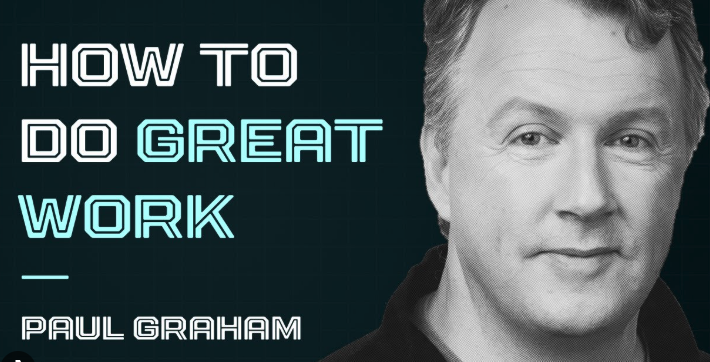
How to Do Great Work · Jul 2023 PG collected advice on doing great work from many fields and looked for what it all has in common. He found a clear pattern: pick work you have both a talent for and a deep interest in, learn enough to reach the edge of what's known, spot the gaps there, and explore the promising ones. Curiosity drives every step. If he had to name the secret in one word, it would be "curiosity."

Choosing what to work on

  • His three tests are aptitude, deep interest, and room for great work. Ambitious people can mostly skip the third, because they already lean too cautious about it.
  • You can't know what a kind of work is like until you do it. So guess, start, and switch if something better turns up. You owe a field no loyalty.
  • Make yourself a big target for luck: try lots of things, meet people, read, ask questions. A good field gets more interesting the deeper you go. Another good sign: you enjoy the parts other people find dull or scary.
  • If you're making something for people, make what you want yourself. Your friends then become your first audience. Don't build for an imagined, more sophisticated crowd.
  • Don't over-plan. At each stage, do what is most interesting and leaves you the best options. He calls this "staying upwind."

Finding new ideas

  • From far away, the edge of knowledge looks smooth. Up close it is full of gaps.
  • A good new idea has to seem bad to most people, or someone would already have tried it. The right kind of crazy idea is exciting and opens up a lot. A merely bad one is depressing.
  • Be stricter than other people. A broken model leaves clues where it doesn't fit reality, and most people look away from them.
  • Ask what your field is "religious" about, meaning what it is too attached to. Also ask what would be a good idea for someone else to explore. Your mind won't shoot those ideas down to protect you.
  • Choosing the problem matters more than solving it. Problems that are out of fashion are undervalued, and so are fields people think are used up.

How to actually work

  • The hardest kinds of work may only last 4–5 hours a day. Protect long blocks of time without interruptions.
  • Starting is harder than keeping going, so it's fine to trick yourself. His trick is "I'll just read over what I've got." Then finish what you start, because the best work often happens at the end.
  • The most dangerous kind of procrastination is putting off a whole project for years. It hides as busy work on other things. Ask yourself now and then: am I working on what I most want to?
  • Start small and improve in versions. Try the simplest thing that could work, and get an early version in front of people. If people dismiss it as a "toy," that's a good sign.
  • Take as much risk as you can afford. If you never fail, you're being too careful.

People and morale

  • Aim to be the best. Trying only to be good doesn't even get you to good.
  • Be earnest: honest with yourself, quick to admit mistakes, and not trying to look a certain way. Put work out into the world instead of criticizing other people's.
  • One or two great colleagues beat a building full of pretty good ones. You will become like the people you work with.
  • Morale compounds in both directions. When you're stuck, switch to easier work. Treat setbacks as a normal part of the process. A small but dedicated audience is enough.
  • Don't let competitors pick your problem.

What he's unsure about

  • There's no precise definition of great work. He doesn't know if originality can be learned, and you can't be sure which crazy ideas are the right kind.

Ask yourself (our questions, not PG's)

  • What part of my market do I find interesting enough that most people would be bored by it?
  • Am I putting off the project I most want to do by keeping busy with other work?
  • What is my industry "religious" about, and what becomes possible if that belief is wrong?